

close
Choose Your Site
Global
Social Media
Views: 0 Author: Site Editor Publish Time: 2026-08-24 Origin: Site


Drive systems in overhead, gantry, and mobile cranes carry immense responsibility. Mechanical failure in these applications translates directly to catastrophic safety risks and severe operational downtime. Modern crane design faces a strict engineering conflict. You must maximize lifting capacity and torque while strictly minimizing the physical footprint and weight of the hoist mechanism on the bridge or boom. The Planetary Gearbox for Crane serves as the industry standard for resolving this conflict. Successful specification requires rigorous evaluation of thermal limits, duty cycles, acoustic performance, and integration requirements rather than just baseline gear ratios. We will break down the technical evaluation process for specifying these components. You will learn how to balance torque density, manage thermal constraints, and select the right configuration for your specific lifting application.
Unmatched Torque Density: Planetary designs distribute loads across multiple planet gears, offering significantly higher torque-to-weight ratios compared to helical or spur gearboxes.
Thermal Management is Critical: The compact volume of planetary gearboxes results in a smaller surface area for heat exchange, making thermal capacity a primary limiting factor in continuous duty cycles.
Orientation and Modularity Dictate Design: Choosing between inline and right angle planetary gearbox configurations fundamentally impacts spatial integration, while plug-in designs dictate motor selection and maintenance accessibility.
Acoustic and Ergonomic Benefits: Precision-engineered planetary systems significantly reduce operational noise and vibration, improving safety and communication in indoor industrial environments.
Vendor Engineering Capability: Selecting an industrial planetary gearbox manufacturer must be based on their ability to provide application-specific load profiling, custom plug-in solutions, and proven reliability metrics.
Standard industrial gearboxes often fail under lifting conditions. Crane operations demand highly specific success criteria. You cannot simply pull a catalog gearbox and expect it to survive overhead lifting. The operational realities of hoisting require drive systems engineered specifically for dynamic, high-stress environments. When a crane lifts a load off the factory floor, the drive system absorbs the entire kinetic energy of that transition.
Minimizing the dead weight of the trolley and hoist assembly remains mandatory. Less dead weight improves overall crane structural integrity. It reduces the load on the bridge girders and runway beams. Lower hoist weight also boosts energy efficiency during travel motions. Every kilogram saved on the hoist translates to higher payload capacity. This torque-to-weight imperative drives the adoption of advanced gearing solutions over traditional parallel shaft designs.
Sudden starts, stops, and load swinging place immense stress on gear teeth. Crane drives rarely operate in steady-state conditions. Operators frequently jog the controls to position heavy loads. This creates severe reversing operations and dynamic shock loads. When a heavy load is lifted, the wire rope stretches. As the load clears the ground, it bounces, sending a shockwave directly back through the drum into the gearbox output shaft. High service factors based on AGMA or ISO standards are strictly necessary to ensure the gear teeth can accommodate these dynamic shock loads without premature fatigue or fracture.
Safety and redundancy dictate strict braking integration. Regulatory requirements mandate mechanical braking for load holding. You must integrate multi-disc spring-applied brakes directly into the gearbox module. These brakes ensure fail-safe operation during power loss. They are typically hydraulically or electromagnetically released. Integrating the brake into the gearbox housing protects it from environmental contamination and ensures direct mechanical engagement with the drive train.
Operational Factor | Standard Industrial Gearbox | Crane-Duty Planetary Gearbox |
|---|---|---|
Shock Load Tolerance | Low to moderate; designed for steady-state running. | Extremely high; engineered for reversing and jogging. |
Brake Integration | External add-on, often exposed to elements. | Fully integrated, enclosed multi-disc fail-safe brake. |
Power Density | Large physical footprint required for high torque. | Highly compact; fits inside or adjacent to the drum. |
Output Connection | Standard keyed shaft, prone to shearing under shock. | Heavy-duty splined shaft or shrink disc connection. |
The kinematic architecture of a planetary system relies on specific interactions. A central sun gear drives multiple planet gears. These planet gears rotate within a stationary ring gear, known as the annulus. A planet carrier connects the planet gears and transfers the output torque. This arrangement keeps the input and output shafts coaxial in inline designs, providing a streamlined profile that fits easily onto crowded trolley decks.
This design offers distinct load distribution advantages. Traditional spur gears transfer torque through a single gear mesh. Planetary systems share the load across three or more planet gears. This load sharing significantly reduces the bending stress on individual gear teeth. It allows engineers to design a highly compact, high torque planetary gear motor setup. The concentrated power density is unmatched by parallel shaft designs.
To achieve true load sharing, the sun gear must float. If the sun gear is rigidly fixed, manufacturing tolerances will cause one planet gear to take more load than the others. A floating sun gear centers itself among the planets. This equalizes the force distribution and prevents premature failure of a single gear mesh. Advanced manufacturers also utilize tip relief and crowning on the gear teeth to prevent edge loading when the system deflects under maximum capacity lifts.
Mechanical efficiency remains high across planetary stages. Each gear stage typically achieves 95 to 97 percent efficiency. High efficiency translates directly to lower power consumption for the prime mover. It also means less power is lost as heat. However, the compact nature of the gears means the heat that is generated concentrates in a smaller volume. The balanced radial forces within the gearbox improve bearing life. Because the planet gears are spaced evenly around the sun gear, the radial forces cancel each other out. This internal balance prevents the input shaft from deflecting under heavy torque, keeping the gear meshes perfectly aligned.
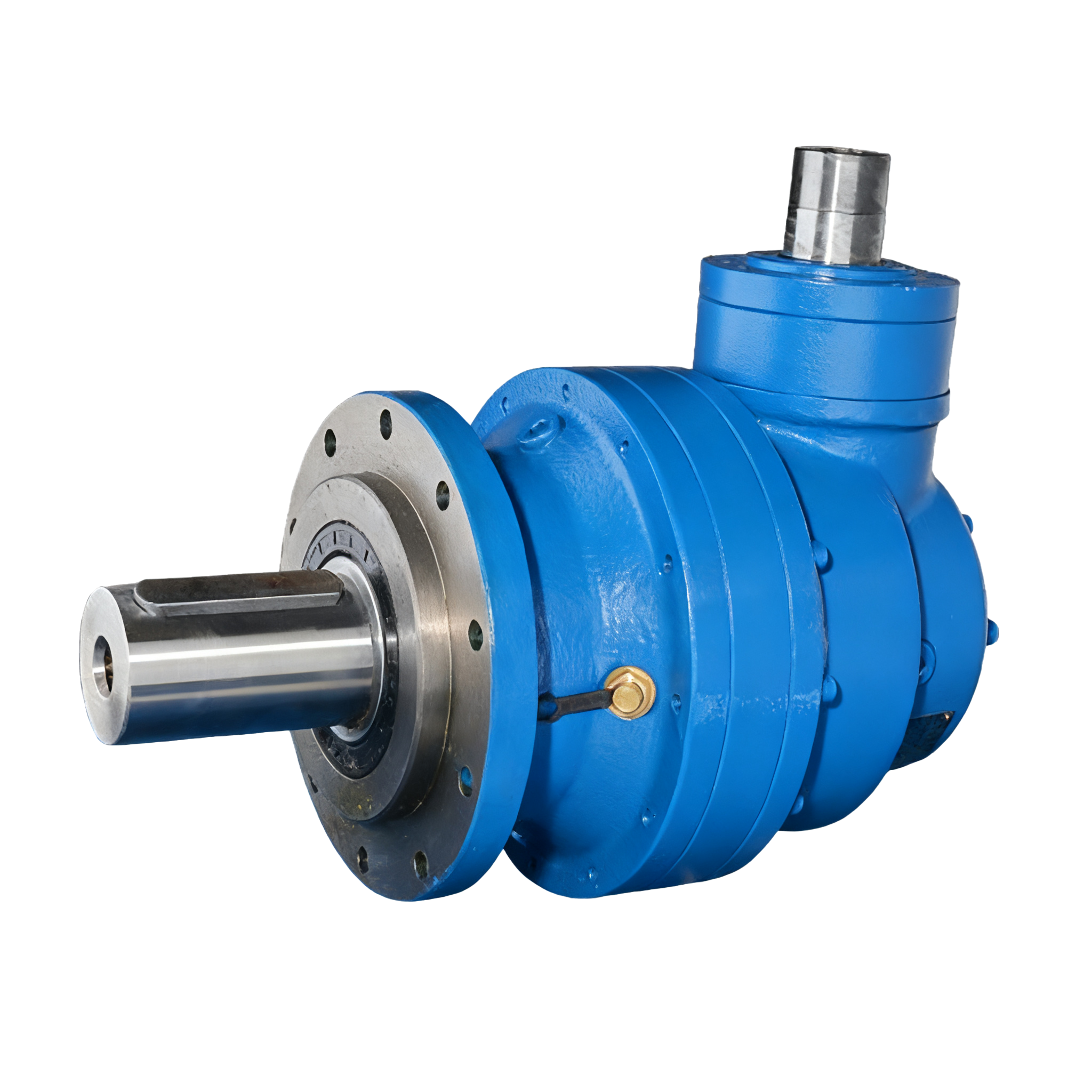
Physical layouts for hoist integration vary based on spatial constraints. You must evaluate the physical space available on the crane trolley or boom. The available envelope dictates the fundamental shape of the drive system. Engineers must measure the distance between the drum flanges and the structural cross-members to determine the maximum allowable gearbox length.
Inline designs work best for drum-integrated hoists. They allow a coaxial motor-gearbox-drum arrangement. The gearbox often sits partially or entirely inside the wire rope drum. This configuration saves immense space on the trolley deck. It provides a clean, streamlined hoist profile. Inline units are highly efficient because they do not require directional changes in the power flow. They connect to the drum using a heavy-duty shrink disc, which creates a zero-backlash friction fit on the drum shaft.
Tight clearances often require a right angle planetary gearbox. Sometimes the motor cannot sit in line with the drum due to structural interference. The motor must sit parallel to the wire rope drum. Adding a bevel gear input stage achieves this 90-degree turn. Spiral bevel gears are preferred for this input stage because they offer smoother engagement and higher load capacity than straight bevel gears. The backlash in the bevel stage must be carefully shimmed during assembly. Improper shimming leads to rapid wear and excessive noise.
Input compatibility drives modularity. Mobile and crawler cranes commonly use hydraulic motors. Overhead industrial cranes rely heavily on electric motors. Planetary plug-in gearboxes offer custom-machined flanges and couplings. They accept either motor type seamlessly without requiring secondary adapters. This plug-in design simplifies maintenance. You can remove the motor without opening the gearbox housing or draining the oil, which drastically reduces downtime during motor replacements.
Measure trolley deck clearances to determine maximum gearbox length.
Specify inline configurations for drum-integrated space savings.
Utilize right-angle configurations when the motor must sit parallel to the drum.
Ensure spiral bevel gears are properly shimmed to prevent rapid wear.
Select plug-in designs to allow rapid motor removal without draining oil.
Reading a manufacturer specification sheet requires a focus on crane operations. You cannot evaluate these drives like standard conveyor gearboxes. Lifting applications introduce unique mechanical and thermal stresses. You must translate catalog specifications into real-world lifting outcomes. Understanding the Fédération Européenne de la Manutention (FEM) classifications is essential for matching the gearbox to the actual duty cycle.
Thermal capacity often supersedes mechanical rating. A gearbox might handle a load mechanically but fail thermally. The compact volume means a smaller exchange surface and lower heat capacity. Continuous duty cycles generate significant heat through gear friction and oil shear. If the heat cannot escape, the oil degrades rapidly, losing its lubricating film thickness. You must evaluate the thermal rating against your specific duty cycle classification and ambient operating temperatures.
Wire rope drums exert severe forces on the gearbox output shaft. As the rope winds across the drum, the fleet angle changes. This creates shifting radial and axial loads. You must evaluate these load capacities rigorously. Heavy-duty, reinforced bearing configurations are non-negotiable for a reliable hoist planetary gearbox. Tapered roller bearings or spherical roller bearings are typically required to handle these combined forces. Engineers typically specify an L10 bearing life of 10,000 to 50,000 hours depending on the FEM classification.
Noise, Vibration, and Harshness (NVH) standards impact safety. Precision-ground gears and optimized tooth profiles reduce operational noise. Lower vibration improves reliability by protecting sensitive electronic components on the crane. It also provides better ergonomic conditions for indoor overhead crane operators. Excessive noise causes operator fatigue and masks important safety warnings on the factory floor. Gear teeth ground to DIN 3990 or ISO 6336 standards ensure quiet, vibration-free operation.
Low backlash ensures precise load placement. Standard lifting may not require zero backlash. However, applications in aerospace manufacturing or nuclear facilities require exact positioning accuracy. High backlash causes the load to bounce or shift when the motor stops. Precision planetary stages minimize this play, ensuring the load stops exactly where the operator intends without dangerous secondary movements.
Deploying a crane planetary gearbox in harsh environments introduces practical challenges. Even the best-engineered drive will fail if implemented poorly. You must anticipate operational risks and design mitigation strategies into the system from day one. Proper installation and maintenance protocols are just as important as the initial engineering specifications.
Managing thermal limits requires active mitigation. High operating temperatures destroy oil viscosity. Use high-performance synthetic Polyalphaolefin (PAO) lubricants to handle elevated temperatures. Implement external cooling loops for severe continuous duty cycles. These loops pump oil through air-to-oil or water-to-oil heat exchangers. Sometimes, intentionally oversizing the gearbox is the best strategy. A larger gearbox increases thermal mass and provides more surface area for heat dissipation.
Vertical or angled mounting orientations risk lubrication starvation. Gravity pulls oil away from upper bearings and gear meshes. If the top bearings run dry, catastrophic failure follows quickly. Specialized oil expansion chambers ensure the gearbox remains completely full of oil regardless of temperature changes. Forced lubrication systems use mechanical pumps to deliver oil directly to critical friction points, ensuring a constant hydrodynamic film.
Heavy loads cause chassis flex and structural deflection. When a crane lifts a maximum capacity load, the trolley frame bends slightly. This flex creates misalignment between the motor, gearbox, and drum. Misalignment leads directly to premature bearing failure and shaft fatigue. Use flexible couplings, such as barrel couplings or gear couplings, to connect the gearbox to the drum. Ensure proper mounting rigidity and utilize torque arms to absorb reaction forces without putting bending moments on the drum shaft.
Contamination poses a severe risk in industrial environments. Steel mills, foundries, and cement plants generate highly abrasive dust. If dust enters the gearbox, it acts as a lapping compound on the gear teeth. Specify multi-lip labyrinth seals with grease purges. These seals create a physical barrier against dust and moisture ingress. Implement a rigorous oil analysis program to check for particulate count, water content, and additive depletion. Finding bronze particles indicates bearing cage wear, while steel particles indicate gear tooth wear.
Unit price matters less than long-term reliability and operational value. A cheap gearbox that fails stops production entirely. Evaluate vendors based on their engineering support and customization capabilities. You need a partner, not just a parts supplier. The right manufacturer will work with your engineering team to integrate the drive seamlessly into your existing hoist architecture.
A qualified industrial planetary gearbox manufacturer performs finite element analysis (FEA). They conduct torsional vibration analysis on the entire drive train. They accommodate custom housing designs and specific drum interfaces. This engineering depth ensures the gearbox matches your exact structural and dynamic requirements. They will also provide detailed 3D CAD models to assist with your trolley layout.
Advanced metallurgy and surface hardening techniques extend Mean Time Between Failures (MTBF). Ask about their gear manufacturing processes. Case carburizing, quenching, and precision grinding produce gear teeth that resist pitting and wear. The surface hardness should typically reach 58 to 62 HRC. Rigorous quality control ensures lifecycle reliability. Review their L10 bearing life calculations to verify the drive will meet your expected operational lifespan.
Supply chain realities dictate uptime. Factor in lead times for replacement planetary stages, custom bearings, and seals. A manufacturer with local assembly and testing facilities provides faster support. Verify their spare parts availability. You cannot afford to wait months for a proprietary seal when a crane is down. Ask for a recommended spare parts list during the initial procurement phase.
Require full load testing documentation before procurement. Demand material traceability certificates (such as EN 10204 3.1) and certified dimensional drawings to verify specifications. Factory Acceptance Testing (FAT) should simulate your actual load conditions. The manufacturer should mount the gearbox on a test stand, apply the rated torque using a dynamometer, and run it until temperatures stabilize. This testing proves the gearbox will perform as designed before it ever reaches your facility.
Request FEA and torsional vibration analysis reports for custom applications.
Verify gear teeth are case carburized to 58-62 HRC for maximum wear resistance.
Confirm local spare parts inventory for critical seals and bearings.
Demand EN 10204 3.1 material traceability certificates.
Require dynamometer load testing during the Factory Acceptance Test.
Planetary gearboxes offer the optimal solution for high torque in compact spaces. They remain the standard for modern crane and hoist drives. However, they require rigorous engineering oversight regarding thermal limits, shock load capacities, and motor integration. You must balance mechanical strength with thermal dissipation to ensure long-term reliability in harsh industrial environments.
Filter options first by duty cycle and thermal capacity. Next, evaluate spatial configuration for inline or right-angle needs. Finally, assess plug-in motor integration requirements. Proper specification ensures the drive system enhances crane safety, minimizes maintenance downtime, and maximizes operational efficiency.
Take these actionable next steps to advance your project:
Compile your exact load profiles and duty cycle classifications based on FEM or ISO standards.
Map out the physical spatial constraints of your trolley or boom assembly using 3D modeling.
Define your mechanical braking and motor integration requirements for fail-safe operation.
Initiate a technical consultation with a qualified manufacturer to review custom flange and coupling options.
A: The primary advantage is unmatched torque density. Planetary designs distribute loads across multiple gears, allowing for a highly compact size. This reduces the dead weight on the crane trolley while improving overall operational reliability and lifting capacity.
A: Planetary plug-in gearboxes offer superior modularity. They feature custom flanges that allow direct, seamless mounting of either hydraulic or electric motors. This flexibility meets specific customer requirements without the need for bulky secondary adapters.
A: Heat generation is managed by addressing the small surface area of the gearbox. Engineers utilize high-performance synthetic oils, strictly manage operational duty cycles, and often integrate external cooling loops. Sometimes, oversizing the gearbox is necessary to increase thermal mass.
A: Yes, but the bevel gear input stage introduces specific limitations. The bevel gears must be properly sized to handle the input torque before it reaches the planetary stages. This often requires careful engineering to match the torque capacity of an equivalent inline model.
A: Sudden starts, stops, and load swinging cause severe gear tooth fatigue. Shock loads require the application of high service factors during the sizing process. Appropriate safety margins ensure the gear motor withstands dynamic forces without premature mechanical failure.
A: Yes, modern planetary gearboxes significantly reduce crane noise. The load distribution across multiple planet gears, combined with precision-ground teeth, lowers Noise, Vibration, and Harshness (NVH) levels. This provides a safer and quieter environment compared to older spur gear systems.