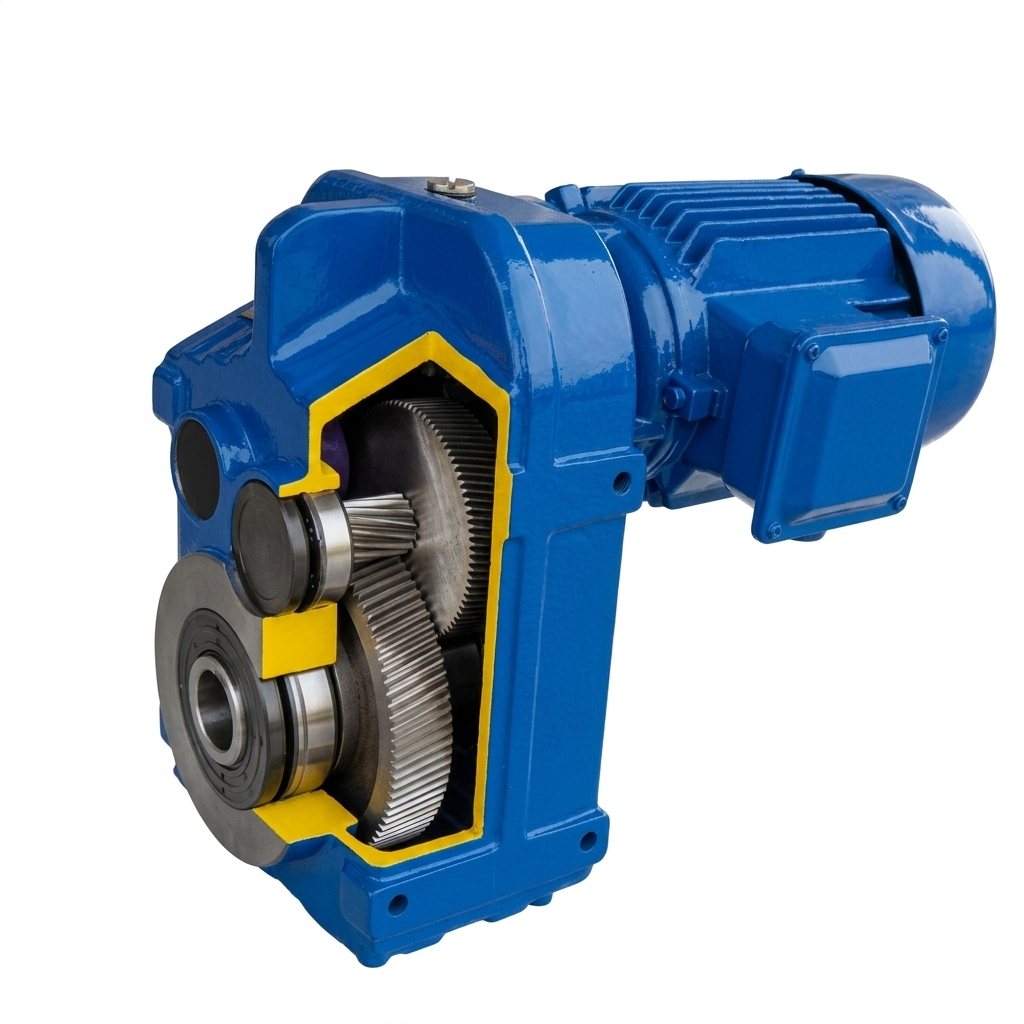
Industrial power transmission demands a delicate balance. Facilities require high torque delivery. They also need robust energy efficiency. Extended operational lifespans remain equally critical. Selecting an incorrect drive mechanism causes massive problems. It easily leads to excessive energy consumption. Operations then face frequent maintenance downtime. They also suffer from premature hardware failure. This guide provides technical buyers and mechanical engineers an objective breakdown. We will explore structural features and operational benefits. You will learn specific evaluation criteria. These metrics help you determine if a Helical Gear Motor fits your exact application. Our breakdown strips away marketing fluff. We focus purely on engineering realities. We examine measurable performance outputs closely. You can use these insights to make smarter procurement decisions. The right choice maximizes productivity. It also minimizes unexpected disruptions on the factory floor.
Key Takeaways
Helical gear motors utilize angled teeth for gradual meshing, resulting in smoother operation, higher efficiency, and greater load capacity than spur gears.
The primary operational benefit is an energy efficiency rating typically exceeding 90-95%.
While offering superior longevity and torque transmission, helical configurations generate axial thrust forces that require robust bearing systems.
Procurement decisions should weigh the higher initial capital expenditure of helical units against their long-term energy savings and reduced maintenance cycles compared to worm gearboxes.
The Core Mechanics: How Helical Gear Motors Operate
Engineers must understand fundamental gear mechanics. This knowledge separates helical designs from alternative solutions. Mechanical designers face constant physics challenges. They must transmit power efficiently across rotating shafts. Helical gears solve these challenges using specific geometric principles. They offer distinct advantages over older spur gear designs.
Gradual Tooth Engagement
Manufacturers cut helical gear teeth at a specific angle. They orient this angle relative to the main gear axis. This specific geometry changes everything about how the gears interact. Contact begins at one extreme end of the tooth. It rolls smoothly across the gear face during rotation. Multiple teeth share the mechanical load simultaneously. This gradual sweep creates a seamless transfer of power. Sudden impacts disappear. Traditional spur gears suffer from sudden tooth-to-tooth collisions. Helical designs eliminate this violent meshing action completely.
Load Distribution
Distributed contact area changes the stress profile inside the gearbox. It lowers localized stress significantly. The system reduces shock loads naturally. It inherently supports high-torque transmission. We see fewer broken teeth under heavy strain. The rolling action disperses internal forces over a wider surface. You gain massive mechanical advantages here. Heavy-duty industrial machines rely entirely on this distributed load profile. It prevents sudden catastrophic failures during startup sequences.
The Axial Thrust Trade-off
Engineering always involves compromise. We must transparently acknowledge the physics of helical gearing. Angled teeth naturally create axial thrust. This force pushes aggressively along the gear shaft axis. It attempts to separate the mating gears laterally. Systems necessitate specialized thrust bearings to survive this force. Standard radial bearings fail quickly under axial loads. Robust thrust bearings maintain mechanical stability. They keep the rotating assembly perfectly aligned. You must account for this design requirement during maintenance planning.
Key Features of Modern Helical Gear Motors
System integrators care about specific structural attributes. We map these features directly to measurable mechanical outcomes. Modern manufacturing elevates the basic Helical Gear Motor. It turns a simple transmission device into a highly refined power unit. Buyers should look for specific characteristics when evaluating vendors.
High-Density Power Transmission
Industrial floor space costs money. Engineers constantly try to shrink equipment footprints. Helical units feature parallel and inline shaft designs. These configurations allow for highly compact profiles. You do not sacrifice torque output. Tight machine spaces welcome these streamlined geometries. You can squeeze massive power into narrow conveyor frames. The high power density solves many spatial engineering nightmares.
Modular Architecture
Facilities face severely restricted spatial envelopes. Standard mounting options offer ultimate installation flexibility. You can choose foot-mounted housings. You might prefer flange-mounted configurations. Shaft-mounted options eliminate external couplings entirely. This modularity speeds up facility design phases. You adapt the drive unit to the machine. You never alter the machine to fit the drive unit.
Precision Machining Tolerances
Modern production improves gear quality drastically. Precision grinding defines the exact tooth profile. Advanced heat-treatment processes harden the raw material. These steps result in minimal mechanical backlash. Precise motion control becomes possible. Automated conveyor lines rely on exact positioning. Packaging systems need perfect synchronization. High tolerance machining guarantees this exact repeatability over millions of cycles.
Thermal Capacity
Continuous duty cycles generate intense internal heat. Friction produces thermal energy rapidly. Optimized housing designs solve this critical issue. Manufacturers cast these housings from iron or high-grade aluminum. These materials dissipate heat effectively. They pull thermal energy away from the internal oil bath. External cooling fins increase the overall surface area. This keeps internal temperatures within safe operating limits. Oil viscosity remains stable. The entire system runs cooler and lasts longer.
Top Operational Benefits & ROI Justification
Engineering features must connect to bottom-line impact. Business success relies on measurable returns. Facility managers need strong justification before approving capital expenditures. The operational benefits of these specific gearboxes provide that exact justification.
Maximum Energy Efficiency
Rolling friction defines helical systems. Sliding friction defines older worm gear units. Rolling action wastes very little energy. It yields up to 98% efficiency per gear stage. This mechanical reality directly reduces electricity costs. Continuous-running applications see massive financial savings. Energy grids strain under heavy industrial loads. Highly efficient gear motors reduce the baseline amperage draw. Your monthly utility bills drop noticeably.
Acoustic & Vibration Reduction
Smooth meshing action lowers ambient noise. Decibel levels drop significantly across the factory floor. This aids directly in strict OSHA compliance. Factories become much safer working environments. Operators experience far less auditory fatigue. Reduced vibration also protects surrounding machine components. Sensitive electronic sensors nearby operate without interference. Smooth power delivery stabilizes the entire production line.
Extended Operational Lifespan
Durability acts as a primary cost-saving metric. Reduced wear on gear teeth matters greatly. It extends the mean time between failures (MTBF). Maintenance crews spend less time replacing worn drives. You avoid expensive emergency repair interventions. The hardened steel components resist pitting and scoring. A well-lubricated Helical Gear Motor runs reliably for decades. This longevity justifies the higher initial purchase price easily.
High Overload Capacity
Industrial environments produce severe shock loads constantly. Helical units handle temporary mechanical overloads easily. They avoid catastrophic tooth fracture. Robust load sharing protects the internal drivetrain. A jammed conveyor belt spikes motor torque instantly. The gearbox must absorb this sudden force. Distributed tooth contact swallows the kinetic energy safely. You reset the breaker and resume production.
Evaluation Criteria: Helical vs. Alternative Gear Technologies
Buyers need an objective comparison. A solid decision framework helps you confidently rule options in or out. Your specific facility constraints dictate the absolute right choice. No single technology solves every engineering problem.
Helical vs. Worm Gears
Worm gears and helical gears dominate the industrial market. They serve very different operational purposes. You must understand their specific boundaries.
When to choose Worm: Extreme budget limits push you toward worm gears. You might need inherent self-locking features. Right-angle drives fit severe space limitations perfectly. Low-duty cycles tolerate lower operating efficiency.
When to choose Helical: High duty cycles demand helical drives. Critical energy efficiency requires them. High-torque demands justify the higher upfront capital cost. They dominate continuous processing applications.
Helical vs. Spur Gears
Helical drives largely replaced spur gears in heavy industry. We see a clear engineering evolution here.
Spur gears cost less to manufacture.
Spur gears lack complex axial thrust issues.
However, industrial applications demand superior noise reduction.
Helical units offer much higher load capacity.
Modern industry prefers helical smoothness for high-speed operation.
Helical vs. Planetary Gears
High-end automation frequently compares these two robust technologies.
Planetary gears offer extreme precision.
They provide maximum compactness for tight robotic joints.
Helical units excel in cost-effective heavy-duty material processing.
They handle bulk industrial tasks better than delicate planetary units.
Gear Technology Comparison Chart
Gear Type
Average Efficiency
Load Capacity
Noise Level
Relative Cost
Helical
95% - 98%
Very High
Low
Medium-High
Worm
50% - 90%
Medium
Low
Low
Spur
95% - 98%
Medium-High
High
Low-Medium
Planetary
90% - 97%
Extreme
Medium
High
Implementation Realities & Maintenance Risks
Deploying equipment on the factory floor exposes practical realities. Experience dictates how you manage these systems. Paper specifications differ from real-world execution. You must anticipate common installation hurdles. Proper planning prevents expensive mechanical disasters.
Lubrication Dependencies
Continuous operation strictly depends on proper oil levels. High-efficiency running demands the exact correct viscosity grade. Oil manages internal heat effectively. It reduces friction between mating metal teeth. Ignoring lubrication schedules leads to rapid catastrophic failure. You must sample the oil periodically. Check for microscopic metal shavings. Synthetic oils often provide better thermal breakdown resistance. Always follow the manufacturer guidelines regarding fluid replacement intervals.
Alignment Criticality
The output shaft must align perfectly. It connects directly to the driven load. Misalignment creates massive mechanical problems immediately. It exacerbates internal axial thrust forces. This leads directly to premature bearing failure. Laser alignment tools prove essential during installation. Flexible couplings absorb minor discrepancies. However, they cannot fix severe geometric misalignment. Take the time to dial in the shaft centers perfectly.
Mounting Rigidity
Heavy torque loads stress the entire physical assembly. A rigid structural foundation prevents dangerous vibration amplification. Solid mounting stops external casing distortion. Flexible or uneven foundations destroy gearbox internals quickly. Secure base plates ensure long-term physical stability. Use heavy-duty structural steel for the mounting platform. Tighten all anchoring bolts to precise torque specifications. Re-check these bolts after the first week of heavy operation.
Common Implementation Mistakes
Skipping the initial break-in oil change after the first 500 hours.
Mounting the unit on an uneven surface, warping the cast housing.
Ignoring external ambient temperatures when selecting oil viscosity.
Over-tensioning drive belts connected to the output shaft.
Shortlisting Logic: How to Specify Your Helical Gear Motor
You must define specific operating parameters. A qualified request for quotation requires exact engineering details. Vague requests yield incorrect product sizing. Guide your procurement team using these exact technical steps.
Determine the Required Service Factor (SF)
Calculate SF based on actual operational hours. Running a machine 24 hours a day needs a higher SF than 8 hours. Load characteristics matter greatly too. Heavy shock loads demand larger service factors than uniform continuous loads. A rock crusher processing granite requires an extreme SF. A small water pump requires a minimal SF. Over-sizing wastes money. Under-sizing guarantees premature failure. Aim for the exact right multiplier.
Calculate Torque & Speed Ratios
Match the gearbox reduction ratio to exact RPM needs. The driven machine requires a highly specific output torque. Incorrect ratios stall the electric motor. They can also overspeed the delicate driven equipment. Start with the motor input speed. Divide it by the required output speed. This gives you the exact gear ratio required. Verify the resulting torque output meets your application demands.
Assess Environmental Compliance
Consider environmental ingress protection carefully. IP ratings dictate necessary dust and water resistance. Standard units fail quickly outdoors. Corrosive environments need specialized epoxy coatings. Washdown duty models serve food processing well. They survive aggressive chemical cleaning agents. Thermal limits dictate external cooling needs. High altitude installations require special motor cooling considerations. Document your exact facility environment before ordering.
Conclusion
A Helical Gear Motor requires a larger initial capital investment. It demands careful attention to shaft alignment. Internal thrust bearings need proper long-term maintenance. However, it offers unmatched mechanical value. Continuous heavy-duty industrial applications thrive on these efficient drives. They outlast cheaper alternatives significantly.
Consult with a qualified transmission engineer next. Calculate your precise service factors together. Evaluate long-term operational expenses before finalizing any procurement. Proper upfront engineering planning guarantees decades of reliable power transmission. Make your choice based on hard data and proven mechanical realities.
FAQ
Q: What is the average efficiency of a helical gear motor?
A: Typically 95-98% per stage. This depends on the exact gear ratio and proper lubrication. It significantly outperforms traditional worm gears in continuous applications.
Q: Are helical gear motors reversible?
A: Yes. Their internal gear geometry allows for bi-directional operation. They reverse without causing internal damage, assuming the connected electric motor supports standard reversing.
Q: Why do helical gears require special bearings?
A: The angled cut of the teeth produces distinct axial thrust forces. These forces push along the shaft. Standard radial bearings cannot adequately support this lateral pressure over time.
Q: Can a helical gear motor be mounted in any orientation?
A: Only if specified in advance. Changing the physical mounting position without modifying the oil fill, drain, and breather plug locations causes severe lubrication failure.