In industrial settings, selecting the right helical gearmotor is crucial for ensuring smooth and reliable operations, especially in high-performance applications. Engineers and technicians must consider a variety of design factors when choosing gearmotors to maximize efficiency, minimize downtime, and reduce noise. With the right design, a helical gearmotor can deliver superior performance and longevity, making it an indispensable component in industries like material handling, automation, and heavy lifting. At BAFFERO, our range of helical gearmotors is designed with these factors in mind, offering a reliable and cost-effective solution for demanding applications.
Tip 1 – Select Correct Helix Angle, Gear Geometry, and Contact Ratio
Choosing the right helical gear geometry is essential for optimizing the performance of a helical gearmotor. The helix angle, gear tooth geometry, and contact ratio significantly influence the smoothness of operation, load-sharing, and noise levels. These factors should be carefully considered during the design phase to ensure maximum efficiency and minimal wear.
Impact on Smoothness, Load Sharing, Noise
The helical gear's teeth are cut at an angle, providing smoother engagement compared to straight-cut spur gears. This angled design reduces the noise and vibration caused by tooth engagement, making it ideal for high-performance systems. The proper selection of helix angle and gear geometry ensures that the gears engage gradually, minimizing shock loading and reducing noise. Additionally, the load is shared more evenly across the gear teeth, which helps distribute forces more efficiently, extending the lifespan of the gearmotor.
Tip 2 – Choose Suitable Mounting Configuration and Mounting Position
The mounting configuration and position of a helical gearmotor play a crucial role in ensuring its efficiency, stability, and performance. Choosing the right mounting type can help optimize space, minimize vibrations, and improve the overall design of the system.
Inline vs Right-Angle vs Shaft-Mounted
A key decision when selecting a helical gearmotor is whether it should be inline or right-angle. Inline gearmotors are ideal for applications where space is at a premium, as they align the motor and gearbox along the same axis. Right-angle gearmotors, on the other hand, offer the advantage of compactness in situations where a change in drive direction is necessary. The modular design of helical gearmotors allows for both configurations, providing flexibility in installation.
Consider Torque Arm, Flange, Foot Mount Options (BAFFERO Offers)
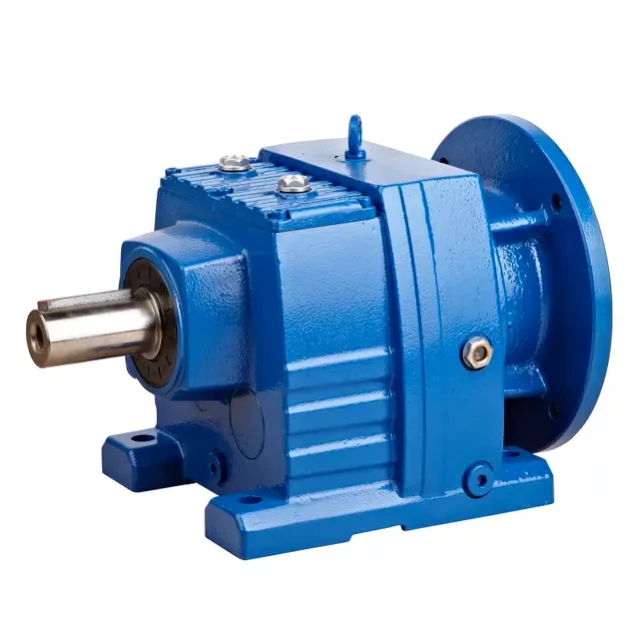
In addition to inline and right-angle configurations, various mounting options can be considered based on the layout and space constraints of the application. Helical gearmotors can be foot-mounted, flange-mounted, or torque-arm mounted. BAFFERO offers all these mounting options in its modular system, allowing customers to choose the best configuration for their specific needs. Foot mounts are ideal for stable, stationary installations, while flange and torque-arm mounts provide more flexibility in dynamic settings, such as conveyors and material handling systems.
Tip 3 – Match Motor and Gearmotor Ratio to Application Duty Cycle
Matching the correct gearmotor ratio to the application’s duty cycle is essential for optimizing both efficiency and lifespan. A gearmotor that is over- or under-specified for the application may lead to inefficiencies, increased wear, or inadequate performance.
Over-Specifying vs Under-Specifying Risks
Over-specifying a helical gearmotor may result in unnecessarily high energy consumption, leading to increased operating costs. Conversely, under-specifying the motor can cause it to work harder than designed, leading to potential overheating, faster wear, and reduced efficiency. It is important to consider the load and speed requirements of the application to ensure the helical gearmotor is appropriately matched to the operational demands.
Consider Continuous vs Intermittent Duty
For applications that require continuous operation, such as in material handling or automation systems, it’s essential to select a gearmotor that is designed for continuous duty. Helical gearmotors that are properly rated for continuous duty will deliver consistent performance without the risk of overheating or excessive wear. In contrast, intermittent duty applications may benefit from a lower-cost, less heavily rated motor, as the load is not sustained over long periods.
Tip 4 – Minimize Noise and Vibration Through Proper Design
Noise and vibration reduction are crucial for creating efficient and quiet operational environments, especially in industries like packaging, food processing, and clean room applications. By focusing on specific design considerations, it’s possible to reduce these factors and ensure smooth and quiet gearmotor operation.
Use Helical Gear’s Smooth Engagement Property
One of the biggest advantages of helical gearmotors over other gear types is their ability to reduce noise due to the smooth engagement of the helical teeth. The angled teeth ensure that multiple teeth are engaged at once, reducing the shock load and distributing the load evenly. This leads to quieter operation and less vibration compared to spur gears, where only one tooth is in contact at any given time.
Ensure Alignment, Mount Rigidity, Damping Elements
Proper alignment and rigid mounting are essential for minimizing vibrations. Misalignment can lead to uneven tooth engagement and increased wear, while lack of rigidity can cause vibrations to propagate throughout the system. Ensuring that the helical gearmotor is installed with proper alignment and a rigid mounting system will reduce these vibrations and contribute to smoother operation. Adding damping elements to the system can also help absorb excess vibrations and minimize noise.
Avoid Axial Thrust Issues
Axial thrust occurs when the gearmotor experiences forces that push the shaft in a direction parallel to its axis of rotation. This can cause premature bearing wear, misalignment, and excessive vibrations. To avoid axial thrust issues, it is crucial to ensure that the bearing design and mounting system are capable of handling these forces. BAFFERO’s helical gearmotors are designed to manage axial thrust effectively, ensuring longer service life and stable operation.
Tip 5 – Plan for Maintenance Access and Service Life from the Start
A key aspect of maximizing the performance and lifespan of a helical gearmotor is planning for easy access to maintenance points during the design phase. Proper maintenance is essential to prevent unexpected downtime and costly repairs.
Modular System Design Advantages
BAFFERO’s modular system design allows for easy access to maintenance points and flexible configurations, ensuring that components can be serviced or replaced with minimal disruption to the operation. The modular design also makes it easier to upgrade or modify the system as operational needs change, without requiring a complete overhaul of the gearmotor.
Use Quality Materials: Cast Iron Housings, Hardened Gears, Proper Lubrication
To ensure a long service life, helical gearmotors should be made with high-quality materials, such as precision cast iron housings and hardened gears. These materials are resistant to wear and ensure that the gearmotor can withstand demanding environments without experiencing premature failure. Additionally, proper lubrication is essential for reducing friction, heat, and wear, further extending the lifespan of the gearmotor.
Tip 6 – Environmental and Installation Factors to Account for
The operating environment of the helical gearmotor plays a significant role in its performance and lifespan. Environmental factors such as temperature, humidity, dust, and exposure to corrosive substances can all affect the performance of the gearmotor. When designing a gearmotor system, it’s important to take these factors into account.
Temperature, Contamination, Dust, Corrosive Atmosphere
High temperatures, excessive dust, or exposure to corrosive chemicals can cause damage to the gearmotor and reduce its operational lifespan. It’s important to select helical gearmotors that are designed to operate in these environments or to implement protective measures such as seals, fans, or ventilation to keep the gearmotor running smoothly.
Select Seals, Breathers, Lubricants Accordingly
In environments with high contamination or temperature fluctuations, selecting the right seals, breathers, and lubricants is critical to maintaining the efficiency and longevity of the helical gearmotor. Seals prevent dust and moisture from entering the motor, while breathers allow for air circulation to maintain internal pressure balance. Choosing the right lubricant ensures smooth operation and minimizes wear in harsh environments.
Conclusion
In conclusion, a well-designed helical gearmotor can offer significant advantages in terms of performance, efficiency, and longevity. By carefully considering factors such as gear geometry, mounting configuration, motor ratio, noise reduction, and environmental conditions, engineers and designers can maximize the life of the gearmotor and minimize operational issues. BAFFERO’s helical gearmotors are designed with these principles in mind, offering a modular system that can be customized to meet the needs of various applications, from conveyors to cranes and material handling systems.
Contact us today to discuss how our helical gearmotors can help you optimize your system’s performance and reduce maintenance costs.
FAQs
Q1: What are the benefits of using a helical gearmotor over other types?
A: Helical gearmotors offer smoother operation, higher efficiency, and better load handling compared to other gear types, making them ideal for heavy-duty and high-speed applications.
Q2: How can I reduce noise in my helical gearmotor system?
A: To reduce noise, focus on selecting the right helix angle, ensuring proper alignment and mounting rigidity, and using quality materials for the gears and bearings.
Q3: What should I consider when selecting a mounting configuration for a helical gearmotor?
A: Consider factors such as space constraints, application type, and whether you need an inline or right-angle configuration. BAFFERO offers a variety of mounting options to suit different setups.
Q4: How can I ensure the long-term performance of my helical gearmotor?
A: Ensure proper lubrication, regular maintenance, and choose high-quality materials like cast iron housings and hardened gears. BAFFERO's modular design allows for easy maintenance access, further extending the service life.


